Case study
HerFlow Insights
Patient-owned perimenopause tracking and doctor-visit preparation
- Type
- Independent product build
- Studio role
- Product design and build
- Services
- Dashboards, Portals
By Linda KisimisiLast updated
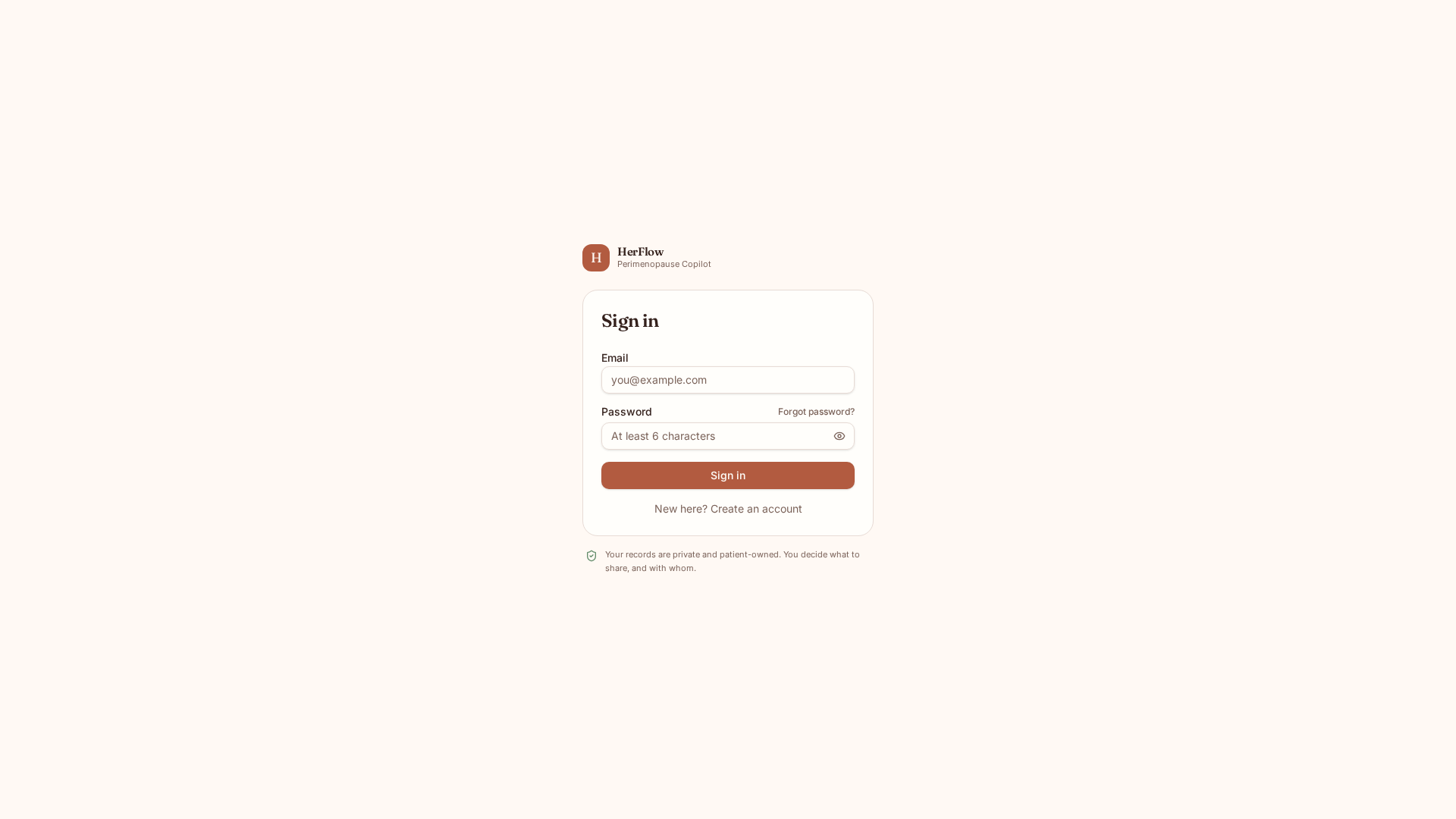
A patient-owned web app for perimenopause that turns daily logs into trends and patterns, with honest confidence language and a structured brief for the next doctor visit.
Context
Perimenopause can involve many changing symptoms over time. A simple diary quickly becomes noise rather than useful evidence.
Design challenge
How do you help someone turn repeated self-tracking into something understandable and useful for a doctor visit - without overstating what the data proves?
Daily capture
Lightweight daily logging across a broader set of signals than a period-only tracker, so patterns have enough context to mean something.
- Symptoms
- Sleep and mood
- Cycle and bleeding
- Energy, stress and focus
- Optional temperature
Patterns with uncertainty
The key design decision: data coverage and pattern strength are kept separate. Instead of presenting every observation as equally certain, the interface uses graded language based on support and data volume - and can simply say there isn't enough data yet.
- Not enough data
- Emerging pattern
- Repeated pattern
- Strong pattern
Tracking changes over time
Users record interventions, and the product compares tracked symptom burden in observational windows before and after each change. These comparisons are explicitly framed as non-causal - they help a user see what changed, not decide whether a treatment works.
Preparing for a clinician conversation
Structured report snapshots and visit summaries gather the evidence in one place. Sharing with a clinic is patient-controlled, with consent and revocation built into the data model. Personalised onboarding and secure sign-in sit underneath.
Boundaries
HerFlow does not diagnose, recommend treatment or claim clinical validation.
What this means for your business
- →Dashboards and reporting that turn messy day-to-day data into patterns your team can actually read
- →Honest confidence language, so reports never overstate what the numbers show
- →Consent-aware sharing, the same pattern we use in client portals where outsiders see only what they should
What this build shows
- Consumer health product design
- Data visualisation and interpretation
- UX writing for uncertainty
- Patient control and consent-aware sharing
- End-to-end product thinking
Want a system like this?
Book a free systems audit. We look at how work flows in your business today and show you what is worth building first.