Case study
Hutano Field Companion
Offline-first tool for Village Health Workers
- Type
- Independent hackathon build
- Studio role
- Product design and build
- Services
- AI assistants
By Linda KisimisiLast updated
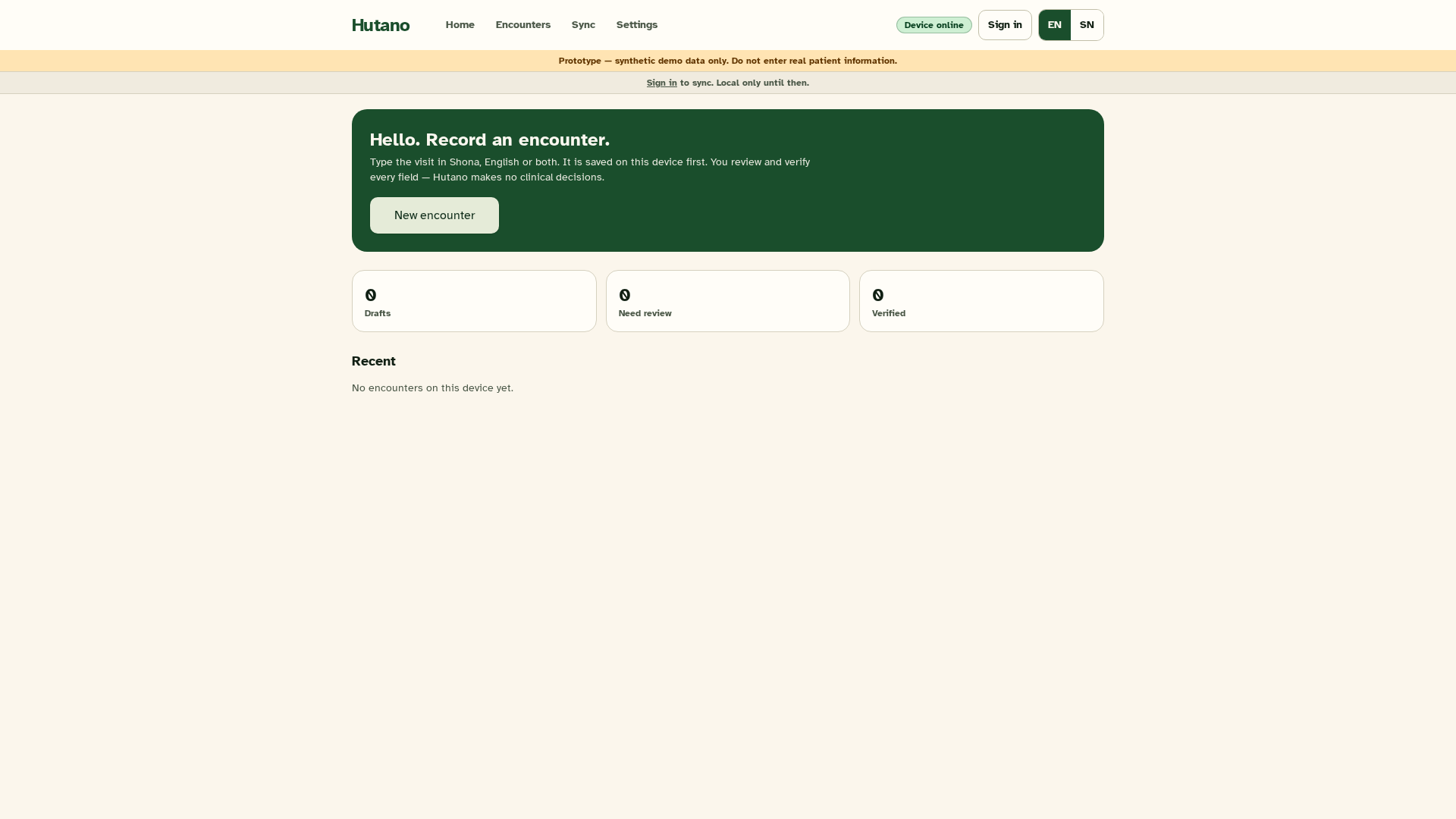
A mobile-first, offline-first companion for Zimbabwean Village Health Workers to record patient encounters in Shona or English.
Context
A solo build by founder Linda Kisimisi for the World Bank Small AI for Development (Health) hackathon. It is a prototype that uses synthetic demo data only.
Design challenge
Three real tensions shaped every screen:
- Useful structure vs. the health worker staying in control
- Offline reliability vs. eventually syncing records
- Shona or English narrative vs. consistent structured records
Workflow
- 1. Worker writes a Shona or English narrative
- 2. Draft is saved locally first
- 3. Extraction suggests structured fields
- 4. Missing documentation is flagged
- 5. Human review: source note beside editable fields
- 6. Explicit verification creates a verified local record
- 7. Verified records move to the sync outbox
Key product decisions
- Drafts are saved before extraction, so a failed extraction never loses the note
- Suggestions stay pending until a person reviews them
- Verification requires every open suggestion to be handled
Safety & human review
Hutano does no diagnosis, treatment recommendation, urgency classification or clinical decision-making. Experimental on-device AI extraction sits alongside manual and demo alternatives, with explicit warnings - it is not clinically validated.
Offline-first, in plain language
After the first online visit prepares the app, capture, review and verification all work without a connection. Records live on the device (IndexedDB). Only verified records are eligible to sync - drafts and records in review never upload.
What this means for your business
- →AI assistants that suggest structured data while a person stays in control of what is saved
- →Offline-first design for field teams, deliveries or sites with unreliable power and data
- →Bilingual capture, useful wherever staff and customers write in more than one language
What this build shows
- Designing for low-connectivity contexts
- Bilingual input flows
- Human-in-the-loop AI
- Safety-first scoping
Want a system like this?
Book a free systems audit. We look at how work flows in your business today and show you what is worth building first.